
Getting Started
Welcome to ADL! This guide will get you up and running with your first project in just a few minutes. By the end, you’ll have a working data solution loaded in the app, ready to explore and build on.
Before you start
Section titled “Before you start”You’ll need:
- A modern web browser: ADL runs in the browser, so Chrome or Edge will work great.
- A local folder for your project: this is where ADL will store all your metadata and templates. We recommend using a folder inside a Git repository so everything is version-controlled from the start, but any local folder will work.
That’s it — no database setup, no server installation, no complex configuration.
The Home screen
Section titled “The Home screen”When you open ADL, the Home screen gives you two options:
- Choose Open Existing Project to pick a local folder that already contains an ADL project. ADL will load all the metadata, templates, and configuration it finds.
- Choose Start New Project to launch a step-by-step wizard that sets up a fresh project from scratch.
If you’ve opened projects before, you’ll also see a Recent Folders list for quick access.
For your first time, choose Start New Project.
Creating a new project
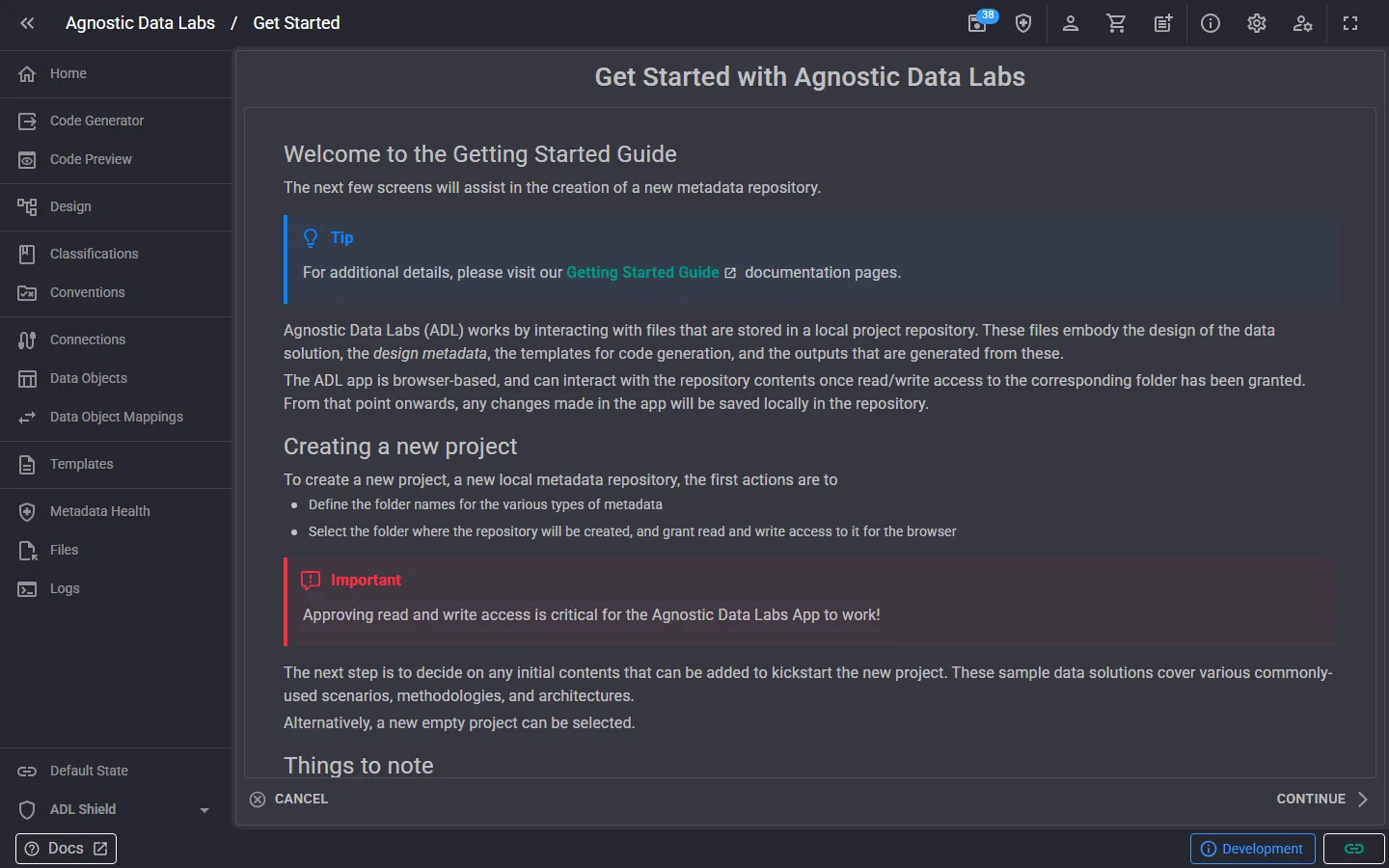
Section titled “Creating a new project”The new project wizard walks you through everything in a few steps.
Step 1: Specify project folders
Section titled “Step 1: Specify project folders”ADL organizes metadata by type, with each type in its own subfolder. The wizard lets you define the folder structure for your project:
- Connections: the data connection files.
- Data Objects: the data object files.
- Data Object Mappings: the mapping files.
- Templates: the template files.
- Output: the generated output.
- Classifications, Conventions, and Project Settings: supporting configuration.
The defaults work well for most projects. You can customize the folder names if you prefer a different layout, and use / to create nested structures.
Step 2: Connect to a folder
Section titled “Step 2: Connect to a folder”Next, you’ll choose the root folder for your project. ADL uses your browser’s file picker to connect to a local folder on your machine.
A few tips for choosing a location:
- A folder inside a Git repository is ideal, because your metadata will be version-controlled from the start.
- Any local folder works fine if you’re just exploring.
- Make sure the browser can access the folder; it needs to be on a local or network-accessible drive.
Step 3: Select initial content
Section titled “Step 3: Select initial content”You can start with an empty project (a blank canvas) or pick a sample solution to get going quickly. Samples come with pre-configured metadata, templates, and conventions for common data solution patterns.
Available samples include:
- Data Vault Virtual Data Warehouse: SQL Server
- Data Vault Physical Data Warehouse: SQL Server
- Willibald: a Data Vault sample based on the community-known Willibald dataset (SQL Server)
- Persistent Staging Area (PSA): SQL Server, Snowflake, or Microsoft Fabric
- Business Model: a conceptual model of core business entities and their relationships
- Metadata Architecture: a conceptual design example
- NBility: a business capability reference model
See Sample Designs for the full catalog. For each sample, you can choose to include metadata, templates, or both.
Don’t worry about picking the “perfect” sample — you can create a new project at any time to try a different one.
Step 4: Create the project
Section titled “Step 4: Create the project”Once you’ve made your selections, ADL creates all the necessary files in your project folder. You’ll see a progress log as everything is set up — this only takes a moment.
Step 5: Done!
Section titled “Step 5: Done!”When the project is ready, click Open Home Dashboard to jump straight into your new project. You’ll see a dashboard with an overview of everything that was created.
Opening an existing project
Section titled “Opening an existing project”If you already have an ADL project folder, choose Open Existing Project from the Home screen. Select the folder in the file picker, and ADL will load everything it finds — data connections, objects, mappings, templates, and configuration.
Previously opened projects appear in the Recent Folders list on the Home screen, so you can reopen them with a single click.
What’s next?
Section titled “What’s next?”Now that your project is set up, here are some good next steps:
- Head to the Data Objects screen to see what was created and how your data objects are structured.
- Open the Design view for a visual map of your data model and relationships.
- Go to the Code Preview screen to see what the templates will generate for your data objects.
- When you’re ready, use the Code Generator to generate all output files at once.
- Connect your own AI provider key to get an in-app AI Assistant that helps you model, map, and generate in natural language.
- Read How ADL Works to understand the metadata, template, and generation workflow in more depth.